
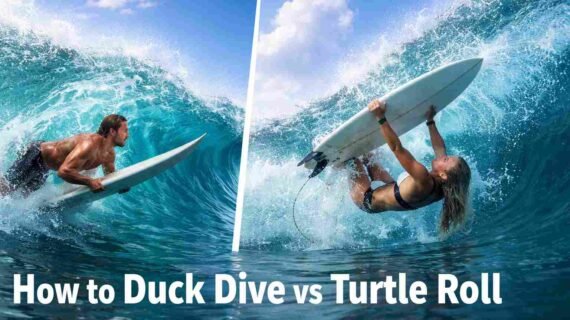
How to Duck Dive vs Turtle Roll is one of the most common questions beginner and intermediate surfers ask when learning how to get past breaking waves efficiently. Both techniques are essential skills for paddling out through the surf, but they are used in different situations depending on board size, wave power, and surfer ability. Understanding when and how to use each method will save energy, improve safety, and help you reach the lineup faster.
Understanding the Purpose of Each Technique
Before diving into the step-by-step methods, it’s important to understand why these techniques exist. When paddling out, waves push toward the shore with force. Instead of fighting that force head-on, surfers either push their board underwater (duck dive) or flip over the board while holding it (turtle roll) to let the wave pass with minimal resistance.
The key difference lies in board volume. Smaller, lower-volume boards can be submerged, while larger, buoyant boards cannot.
What Is a Duck Dive?
A duck dive is a maneuver used primarily with shortboards, hybrid boards, and some funboards. The goal is to push the nose of the board underwater, follow with your body, and allow the wave to pass above you.
When to Use a Duck Dive
Use a duck dive when:
- Riding a shortboard or low-volume board
- Facing medium to large breaking waves
- You need speed and efficiency paddling out
- You have enough upper-body strength to submerge the board
Step-by-Step Duck Dive Technique
1. Build Momentum
Paddle toward the wave with steady speed. Momentum makes it easier to penetrate the water.
2. Push the Nose Down
Place your hands on the rails near the nose and push down sharply, sinking the front of the board.
3. Drive the Tail Under
As the nose goes under, use your knee or foot on the tail to push the rest of the board beneath the surface.
4. Level Out Underwater
Flatten your body along the board to reduce drag while the wave passes overhead.
5. Angle Up and Resurface
Point the nose upward and let the board’s buoyancy bring you back to the surface, ready to paddle again.
Common Duck Dive Mistakes
- Not paddling fast enough before diving
- Trying to dive too late
- Keeping the body too stiff
- Letting the board pop up too early
What Is a Turtle Roll?
A turtle roll is used when riding longboards or high-volume boards that cannot be submerged. Instead of pushing the board underwater, you flip yourself and the board upside down while holding the rails, allowing the wave to pass over the bottom of the board.
When to Use a Turtle Roll
Use a turtle roll when:
- Riding a longboard or foam board
- The board is too buoyant to duck dive
- Facing whitewater or smaller breaking waves
- You need stability rather than speed
Step-by-Step Turtle Roll Technique
1. Approach with Controlled Speed
Paddle toward the wave and keep the board straight.
2. Grab the Rails Firmly
Hold the rails near the middle of the board.
3. Roll Over with the Board
Flip yourself and the board upside down so your back faces the ocean floor.
4. Keep the Board Close
Pull the board toward your chest to prevent it from being ripped away by the wave.
5. Roll Back and Continue Paddling
After the wave passes, rotate back onto the board and resume paddling immediately.
Read more: Will Bali Run Out Of Fuel
Common Turtle Roll Mistakes
- Letting go of the rails
- Staying too loose and getting pulled backward
- Rolling too early or too late
- Not keeping the board perpendicular to the wave
Read more: Why Falling Is Part Of Becoming A Surfer
Key Differences Between Duck Dive and Turtle Roll
The biggest difference is efficiency versus necessity. A duck dive is faster and keeps forward momentum, making it ideal for performance surfing. A turtle roll is slower but essential when riding boards that cannot be submerged.
Duck dives rely more on strength and timing, while turtle rolls rely more on positioning and control. Advanced surfers often prefer duck dives because they conserve energy over long sessions, but longboarders master turtle rolls because it’s the only reliable way to get through breaking waves.
Read more: Can You Brush Your Teeth With Tap Water In Bali
Which Technique Should You Learn First?
Your board determines your priority. If you ride a longboard, start by mastering the turtle roll because it will be your main method of getting past waves. If you ride a shortboard, focus on duck diving early, as it’s a foundational performance skill.
Surfers who transition from longboards to smaller boards often need time to build the strength and timing required for an effective duck dive, so practicing in smaller surf helps accelerate learning.
Read more: Ocean Awareness Tips For Beginners
Tips to Improve Both Techniques
Practice timing in smaller waves before trying bigger surf. Strong paddling fitness improves both maneuvers significantly. Watching the wave and committing fully to the technique prevents hesitation, which is the most common reason surfers get pushed back.
It also helps to keep your body relaxed. Tension increases drag and reduces control, while a smooth, fluid motion allows the wave energy to pass without resistance.
Read more: What To Be Careful Of When Visiting Bali
Final Thoughts
How to Duck Dive vs Turtle Roll ultimately comes down to understanding your equipment and the ocean conditions. Both techniques serve the same purpose — getting you through waves — but mastering the right one for your board will make your sessions more efficient, less tiring, and far more enjoyable.