
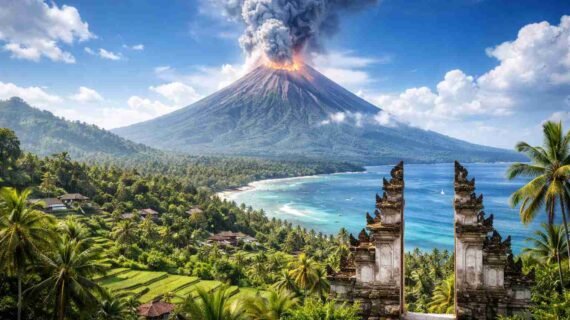
How far is Bali from the volcano eruption? This is one of the most common questions travelers ask when planning a trip to Bali, especially when news about volcanic activity in Indonesia appears. The answer depends on which volcano is erupting, as Indonesia is home to over 130 active volcanoes spread across the archipelago. However, most volcanic eruptions that make international headlines are often located on different islands, meaning Bali is usually at a safe distance.
Understanding Bali’s Location in Indonesia
Bali is part of the Indonesian island chain, located between Java and Lombok. It sits within the Pacific “Ring of Fire,” a region known for frequent volcanic and seismic activity. Despite this, Bali itself remains a well-developed and closely monitored tourist destination.
The island’s main volcano, Mount Agung, is located in the eastern part of Bali. When discussing volcanic eruptions and their distance from Bali, it’s important to distinguish between eruptions happening on Bali itself and those occurring on other islands like Java or Flores.
Distance from Bali to Common Eruption Sites
Mount Agung (Bali)
Mount Agung is Bali’s most active volcano. If an eruption happens here, the distance depends on where you are staying on the island:
- Ubud: around 30–40 km from the volcano
- Canggu & Seminyak: about 70–90 km away
- Denpasar Airport: approximately 60–70 km away
Even during past eruptions, most tourist areas remained safe, with exclusion zones set up within a specific radius (usually 6–10 km from the crater).
Mount Bromo & Mount Semeru (Java)
These famous volcanoes are located on the neighboring island of Java.
- Distance from Bali: approximately 300–400 km
- Travel involves a ferry crossing and land transport
Eruptions here rarely affect Bali directly, although ash clouds can sometimes disrupt flights depending on wind direction.
Mount Rinjani (Lombok)
Located on Lombok Island, just east of Bali:
- Distance from Bali: about 100–150 km
- Separated by the Lombok Strait
While closer than Java, eruptions at Mount Rinjani typically have minimal impact on Bali tourism, though flights may occasionally be affected.
Read more: When Shouldn’t You Visit Bali
Mount Lewotobi & Other Eastern Volcanoes
Volcanoes in Flores or further east are:
- 500–1,000+ km away from Bali
These eruptions generally have no direct effect on Bali due to the large distance.
Read more: Why Softboards Are Perfect for First Surf Lessons
How Volcano Eruptions Affect Bali
Even if a volcano is far away, there are a few ways Bali can still be impacted:
Flight Disruptions
Volcanic ash can travel through the atmosphere and affect flight routes. Airports like Ngurah Rai International Airport may temporarily close if ash clouds enter the airspace.
Air Quality
In rare cases, ash may reach Bali, but this is uncommon unless the eruption is large and winds blow toward the island.
Safety Zones
If Mount Agung erupts, local authorities establish safety zones, keeping residents and tourists at a safe distance from the crater.
Read more: Is Tourism Declining in Bali
Is Bali Safe During a Volcano Eruption?
Yes, Bali is generally safe—even during volcanic activity. Indonesian authorities closely monitor all volcanoes and provide real-time updates. Tourist areas such as Canggu, Seminyak, Uluwatu, and Nusa Dua are far from high-risk zones.
Hotels, tour operators, and local governments are well-prepared with contingency plans, ensuring visitor safety at all times.
Read more: A Day in the Life of a Surf Instructor in Canggu
What Should Travelers Do?
Stay Updated
Check official updates from Indonesian disaster management agencies and your airline.
Follow Local Advice
Always respect exclusion zones and safety warnings.
Have Flexible Plans
In case of flight delays or cancellations, it’s wise to have travel insurance and flexible booking options.
Read more: What Are the Biggest Risks in Bali
Why Bali Remains a Top Destination
Despite being in a volcanic region, Bali continues to attract millions of visitors each year. The island’s infrastructure, safety measures, and distance from most major eruptions make it a reliable and safe travel destination.
Volcanoes are also part of Bali’s natural beauty and cultural significance, adding to the island’s unique charm rather than taking away from it.
Read more: How to Improve Your Pop-Up Technique Fast
FAQ
Most eruptions occur hundreds of kilometers away from Bali, typically between 300 km and over 1,000 km depending on the volcano.
Yes, mainly due to ash clouds, which can lead to temporary airport closures or flight delays.
In most cases, yes. Bali remains safe as long as travelers follow official guidelines and stay outside restricted zones.
Mount Agung is the closest and located directly on the island of Bali.
It is rare and depends on wind direction and the size of the eruption.
Not necessarily. Most eruptions do not significantly impact Bali, and travel can continue as normal with minor adjustments.