
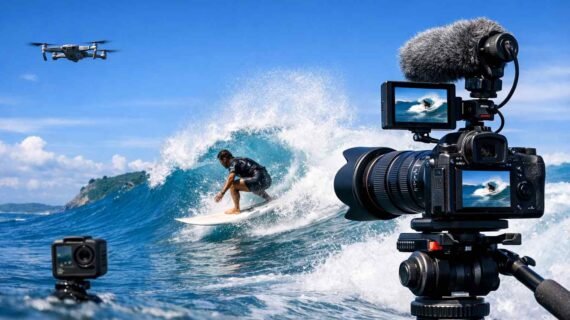
How to Film Your Surf Progress is one of the smartest ways to accelerate your improvement in the water. Watching yourself surf provides honest feedback that you simply can’t get from memory alone. From identifying stance issues to refining timing and wave selection, recording your sessions helps you see what’s really happening and track your development over time.
Why Filming Your Surfing Helps You Improve Faster
Surfing happens quickly, and it’s difficult to remember every detail of a wave once you’re back on the beach. Video removes the guesswork. When you watch your rides, you can clearly see your pop-up technique, posture, and positioning on the wave.
Filming also builds awareness. Surfers often think they’re bending their knees enough or looking down the line, but video reveals the truth. This clarity allows you to focus on specific adjustments instead of trying random fixes.
Another big advantage is motivation. Seeing progress over weeks or months keeps you inspired and committed, especially during plateaus.
Choosing the Right Equipment
You don’t need a professional film crew to capture useful surf footage. The best setup depends on your budget, location, and how often you want to film.
Action Cameras
Action cameras are the most popular option because they’re compact, waterproof, and easy to mount. You can attach them to your board, hold them on a pole, or ask a friend to film from the water. This angle is great for analyzing pop-ups and body positioning.
Smartphones From the Beach
A modern smartphone with a tripod can capture surprisingly good footage. Filming from the beach gives you a wider perspective, making it easier to evaluate wave choice, timing, and turns.
Land-Based Cameras or Videographers
If you want the most detailed analysis, filming from shore with a zoom lens provides the clearest view of your technique. Even occasional sessions with a dedicated filmer can be extremely valuable.
Best Angles to Capture Your Technique
Different angles reveal different aspects of your surfing. Combining perspectives gives you a complete picture of your performance.
Filming from the beach shows your positioning in the lineup and how you read waves. Water-level footage highlights balance, stance, and rail engagement. A slightly elevated angle, such as from a headland or drone (where permitted), helps you see your lines and turns more clearly.
If possible, aim to capture both frontside and backside rides. Many surfers discover they have strong imbalances between the two.
When to Film Your Sessions
You don’t need to record every surf. Instead, be intentional about when you film.
Film when you’re working on a specific skill, such as improving your bottom turn or pop-up speed. Recording during similar conditions each time also makes it easier to compare progress.
Early in your learning journey, filming once every few sessions is usually enough. As you become more advanced, you may want more frequent footage to refine smaller details.
How to Review Your Footage Effectively
Filming alone won’t improve your surfing unless you review the clips with purpose. Try to watch your footage soon after the session while the waves are still fresh in your mind.
Start by watching without judgment to get an overall feel. Then review again and focus on one element at a time, such as:
- Pop-up speed and stability
- Body posture and knee bend
- Where you look during the ride
- Timing of turns
- Wave positioning
Taking notes helps you stay focused in your next session and prevents you from trying to fix too many things at once.
Using Video Analysis to Set Goals
The biggest benefit of surf filming is turning observations into clear goals. Instead of saying, “I want to surf better,” you can set specific objectives like:
- Stay lower during turns
- Look down the line earlier
- Start paddling sooner
- Finish maneuvers with more control
This targeted approach makes your practice sessions far more productive.
Read more: Is 200000 A Good Tip In Bali
Common Mistakes When Filming Surf Progress
One common mistake is filming inconsistently. Random clips taken months apart make it hard to track real improvement. Try to keep a simple timeline of your footage.
Another mistake is being overly critical. Remember that video is a tool for growth, not judgment. Focus on small improvements rather than perfection.
Poor camera placement can also limit what you learn. If the surfer is too far away or blocked by other riders, the footage won’t be very useful. Prioritize clear, steady shots whenever possible.
Read more: Best Sunset Surf Experiences In Bali
Organizing and Tracking Your Surf Clips
Creating a simple archive helps you see long-term progress. You can organize clips by date, location, or skill focus. Even a basic folder system on your phone or computer works well.
Some surfers like to create short highlight reels every few months. This not only tracks improvement but also keeps motivation high.
Read more: What Not To Do In Bali As A Tourist
How Often You Should Film to See Progress
There’s no strict rule, but consistency matters more than frequency. Filming once or twice a month is enough for most surfers to notice changes. If you’re training seriously or preparing for competition, weekly filming can provide deeper insights.
The key is to compare footage from similar conditions so improvements are easier to recognize.
Read more: Why Morning Surf Sessions Are The Best
Turning Footage Into Faster Improvement
The real magic happens when you connect what you see on video with what you feel in the water. After reviewing clips, go into your next surf with one or two clear focus points. Keep them simple so they’re easy to remember while riding waves.
Over time, this cycle — surf, film, review, adjust — becomes a powerful learning system that continuously sharpens your technique.
Read more: How Do You Say Please In Bali
Conclusion
How to Film Your Surf Progress is not just about capturing cool clips; it’s about creating a feedback loop that helps you evolve as a surfer. With the right equipment, consistent filming, and thoughtful review, you can identify weaknesses, reinforce strengths, and stay motivated throughout your journey.
By making video analysis a regular part of your routine, you’ll gain a clearer understanding of your surfing and see measurable improvements far sooner than relying on feel alone.